After a pipe fails, water follows the easiest path. It wicks up drywall, runs along the top of a bottom plate, soaks into subfloor and spreads under cabinets. A wall can look fine while the framing behind it is saturated. That is why drying work leans so heavily on instruments rather than touch.
A good moisture assessment establishes a dry standard by measuring similar materials in an unaffected part of the house. Readings in the wet area are then compared to that baseline, and the comparison, not a single number, shows progress.
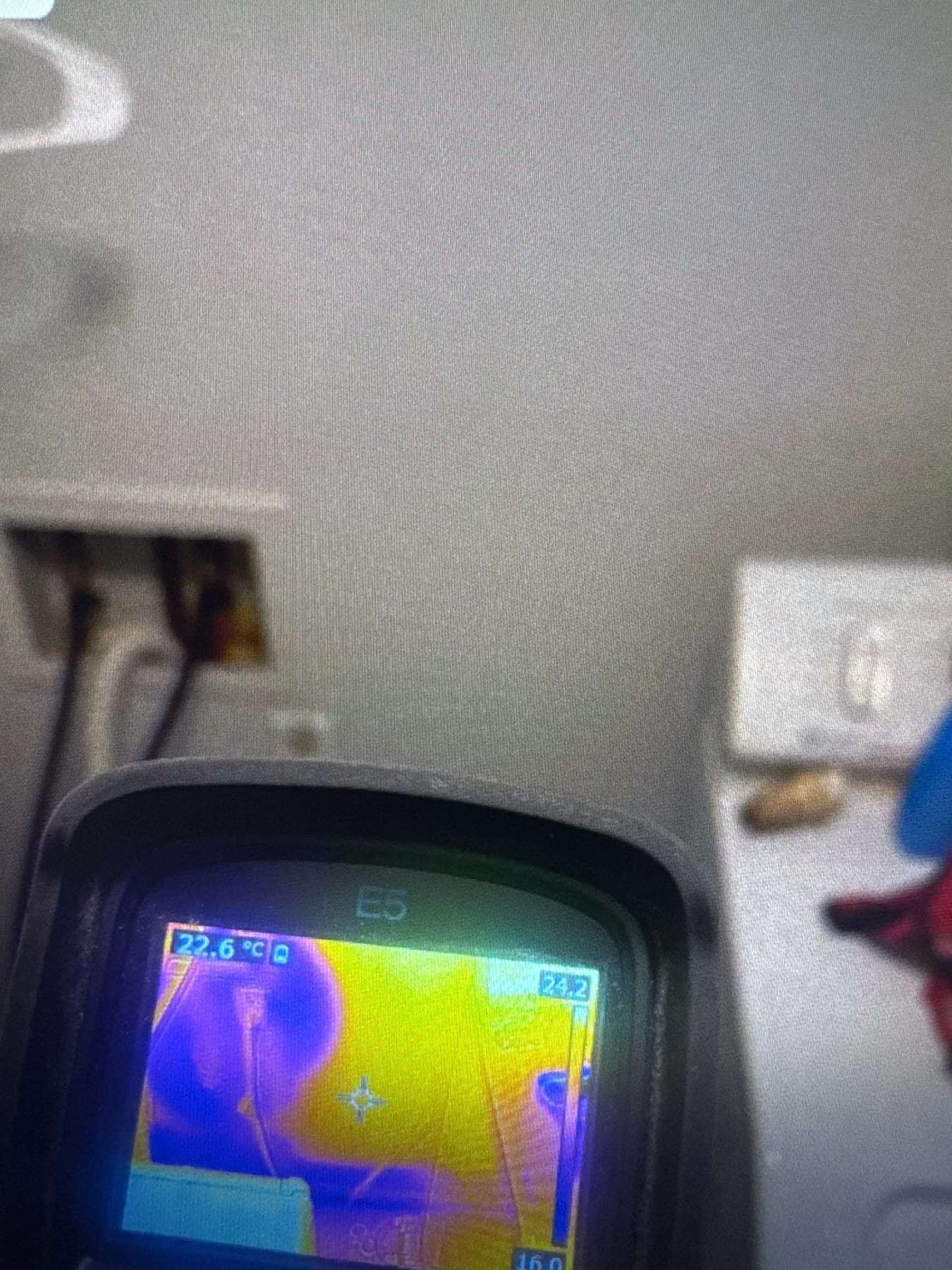
Thermal camera showing a cool patch on a textured wall. A general example of this kind of work, not a photo of a particular home, business or job.
Tools and terms you may hear
- Pin meter
- A moisture meter with two pins pushed into wood or drywall. It gives a reading for that spot and depth.
- Pinless meter
- A meter pressed against a surface that estimates moisture below it without making holes. Good for scanning large areas quickly.
- Thermal camera
- Shows surface temperature differences. Evaporating water often looks cooler, so it helps find wet areas, but it does not measure moisture directly.
- Hygrometer
- Measures air temperature and relative humidity, used to track how well dehumidifiers are working.
- Dry standard
- Readings taken from unaffected materials of the same type, used as the target for drying.
- Moisture map
- A sketch or diagram of the affected area marking where readings were taken and their values over time.
How a moisture map usually comes together
Set the baseline
Readings are taken on dry walls, floors and framing elsewhere in the house.
Find the edges
The technician scans outward from the source until readings return to normal, marking the boundary.
Record numbered points
Specific spots are marked so the same places can be measured each visit.
Track daily
Readings are logged with the date, along with room temperature and humidity.
Close out
Drying ends when the marked points match the dry standard, not when the equipment has run a set number of days.
Places water commonly hides after a supply line break
| Location | Why it stays wet | How it is usually checked |
|---|---|---|
| Behind kitchen and bath cabinets | No airflow; toe kicks trap water | Meter readings through the cabinet back or toe kick |
| Under tile or vinyl flooring | Surface blocks evaporation | Readings at grout lines or seams; sometimes a test lift |
| Bottom plates of walls | Water pools along the framing | Readings near the floor; small inspection holes |
| Subfloor under hardwood | Wood layers absorb water from below | Readings from above and, if accessible, the basement ceiling |
| Insulated exterior walls | Batts hold water against studs | Thermal scan and readings; removal if soaked |
General information for Denver, not a quote or professional advice. In an emergency, call 911.